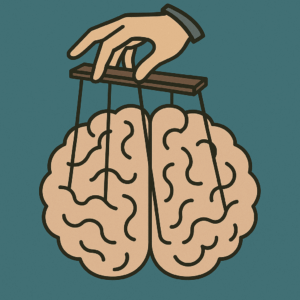
 When we (humain beings) used to be hunters, fishers and gatherers, the number 1 goal was to remain in life, by finding food and bringing it back « home », by procreating with the unconscious hope to increase the survival rate and of course by avoiding the numerous dangers of the environment: animals, quicker and stronger, diseases, other humans…
When scientists compare their brains, with ours, although there are serious differences like size and weight, the most significant one is the size of the prefrontal lobe, located in the Neo-Cortex, the most recent development of the brain.
The Pre-frontal lobe is without any doubt what makes us « human », compared to other parts of the brain, present at mammals as well, for a long time.
Among the associated functions, we find the capacity to anticipate, to plan, to make decisions, to use creativeness, to moderate social behaviours…
If this « rational » part of the brain is very useful, the access to its resources is quite slow. In many situations, it is too slow. Back to immemorial times, it would have been much too slow with regards to dangers and the interception of crucial elements (food, information…) by instinct of self-preservation.
This explains, among other elements, why our brain created shortcuts (heuristics), aiming at reaching five objectives:
1) Help select information
2) Contribute to increasing the speed of action
3) Create meaning where there isn’t any
4) Help memorize crucial elements
5) Help simplify
If these goals are really helpful, we are fortunately (or not) more evolved than « Homo sapiens sapiens » and these shortcuts are less (or not any more) helping survive in the physical meaning of the word, but surviving in an ocean of information and data.
To a certain extend, and according to certain neuroscientists, these mechanisms are not adapted any more to our everyday’s life.
As a consequence, useful shortcuts can turn into traps, pitfalls, errors with impact on the process and the quality of our decisions and our actions.
As this knowledge is also used by marketeers, advertising executives, sales people… to their benefits, it means we are looked at, as sitting ducks, when it comes to making us act, decide, express instead of others, without in many cases, any benefit for us. Ever heard about:
- Anchoring
- Priming
- Illusion of control
- Framing
- Contrast
- Confirmation
- Illusion of transparency
- Availability
- Groupthink
- Overconfidence
- Escalation of commitment
- Illusion of freedom
- …
Just as an example: Laurent is a thin man who wears glasses and loves to listen to Mozart’s music. What is most probable :
- Laurent is driving trucks in Italy
- Laurent is professor of literature in Liège
- Laurent is lion-tamer in Dublin
- Laurent is football coach in Marseille
- Laurent is piano tuner in Salamanca
- …
Do you have the right answer?
Another small example:
Imagine you are standing in front of three doors and you have to open one of them.
- Behind the first one, there is a raging fire
- Behind the second one, there is a band of murderers
- Behind the third one, there is a lion who did not eat for 3 months
Which one should you choose?
A last example before leaving each other: Your are driving a bus with ten passengers. At the first stop, 6 persons get into the bus and 4 get out of the bus. At the second stop, 4 persons get into the bus and 5 get out of the bus. At the third stop, 7 persons get into the bus and 3 get out of the bus. At the fourth stop, 3 persons get into the bus and only 1 get out of the bus. How old is the driver? You don’t know? Read again!