
Making an error in judgment, choice, or decision can prove fatal or extremely serious for the doctor who performs an unfortunate medical procedure, the engineer who makes a mistake in his calculations and causes a bridge to collapse, the pharmaceutical company that markets a drug with harmful side effects, the food industry that allows highly toxic foods to pass through, a jury and judges who convict an innocent person, police officers who commit a blunder, the asset manager who invests a client’s money and loses it…
There are safeguards in these disciplines. They were invented and designed in response to the difficulties encountered and the damage caused, with a time lag. They help to reduce the number of such situations, but unfortunately cannot eliminate them all:
- Checklists
- Checks and double-checks
- Procedures
- Audits
- Pre-mortems
- …
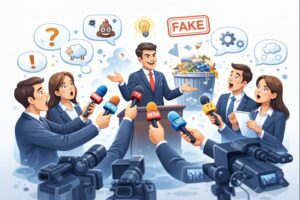
There is one profession whose practice presents indirect dangers, both for those who practice it and for the public. That profession is journalism.
Let’s avoid generalizations, as they would be unfair, unfounded, and unnecessarily harmful. First of all, we must distinguish between different types of journalism: investigative, political, health, sports, religion, weather, general news, film/theater, history, fashion, etc. Do they mainly record and transmit facts (established?) and data (verified?) or ideas and judgments? Let us therefore remain cautious without blurring the lines or denying certain obvious facts.
This profession, like many others, is affected by various mechanisms, difficulties, errors, failures, pitfalls, etc., particularly when these professionals have to share their opinions and information. The purpose of this article is to describe some of these and to offer some food for thought.
While journalists are supposed to be and remain independent of political powers, and are supposed to seek and convey “the truth” (insofar as it is within reach, of course), they are unfortunately subject to the harsh laws of commerce.
Between the editorial lines that they seem obliged to follow, the ever-increasing pressure to be the first to broadcast information, and unofficial affiliations or connections to political movements, what is left to exercise a profession that gives the impression of becoming increasingly sensationalist instead of serving as a reference for information?
A medical procedure that results in the death of a patient or lifelong disability is a tragedy. The collapse of a bridge that causes injuries and deaths is a tragedy. A pile-up, a plane crash, two trains colliding head-on, a fire, an explosion—these are tragedies. And the list does not end there, unfortunately.
What about information that is truncated, erroneous, misleading, biased, reductive, exaggerated, or ignored? Without accusing the profession of intellectual dishonesty, of course, or of malice, which would certainly be an unacceptable exaggeration!
The average person, you and I, does not necessarily realize this, or at least not right away. Is it the norm in our society, a side effect of the frantic search for scoops, the exaggerated expression of certain ideas, the immoderate pursuit of results, immaturity, credulity, laziness on the part of readers…? The reality probably lies at the intersection of these and other reasons. One thing is certain: journalists have an enormous impact on us and, as a result, an equally enormous responsibility when conveying (sometimes) dubious information and opinions.
This toxicity is primarily mental, and its consequences are difficult to measure. However, the effects can be dramatic, as they stifle critical thinking, lobotomize reasoning and judgment, and ultimately result in choices that are not our own.
Each generation has seen an increase in the number of decisions to be made on a daily basis compared to the previous one. Yet the days are no longer, nor are the demands any less, quite the contrary. It is unthinkable to stop this acceleration, just as it is impossible for us to escape the race for turnover, profit margins, market share, and notoriety.
What factors can we influence? Which ones are beyond our control?
- The editorial policy of the media outlet represented
- Political sympathies, collusion, and obligations
- Personal beliefs
- Personal values
- Exaggerations, generalizations, stereotypes, and prejudices
- The process of acquiring information
- The process of verifying information
- The decision-making process for sharing (or not sharing) news
The first two elements are generally beyond our sphere of influence, unless we want to play Don Quixote…
The next three will give us a lot of trouble, because changing beliefs is a long-term endeavor, and we are not talking here about changing other people’s values.
That leaves the last three: what do journalists do to acquire, verify, and share information?
In particular, what are the obstacles, pitfalls, traps, and shortcuts?
Here are six to start with, which have enormous staying power and which, on their own, represent a significant part of the sclerosis of our critical thinking:
- Anchoring bias – (already discussed in the article Masonry, boats, negotiation: what do they have in common? Anchors – https://www.linkedin.com/post/edit/6562684050040070145/)
- Hypothesis confirmation bias (already discussed in the article Recruiting the best: obviously. Even if the biggest obstacle is us! https://www.linkedin.com/post/edit/6573904396437065728/)
- Groupthink (already discussed in the article Recruiting the best: obviously. Even if the biggest obstacle is us! https://www.linkedin.com/post/edit/6573904396437065728/)
- The mere-exposure effect
- Information availability bias
- Framing bias
Let’s take a closer look at the last three.
The mere-exposure effect
What makes us buy Dash rather than Ariel, both of which are available in the laundry detergent aisle of a supermarket? The answer to this question is obviously not trivial. One of the reasons is the mere-exposure effect, which consists of feeling closer (less distant) to things we have been exposed to several times. This applies to a face, a piece of music, an object, a name, a taste… Search engines such as LinkedIn, Facebook, and Amazon use this effect, among other things.
What can we deduce from this? A phenomenon of gradual habituation, even to things that are furthest from our tastes, motivations, and desires. And this can cause serious damage.
The availability bias
In your opinion, will you find more words beginning with the letter “k” than words whose third letter is “k”?
In your opinion, do the United States record more deaths from sharks or from falling aircraft parts?
Which is more likely: being the victim of a road accident or a plane crash? The answer is well known. The probability is much higher in a car than in an airplane. Yet, after every plane crash, people are much more shocked. First of all, it is almost impossible to survive, and secondly, the number of deaths is much higher. These two factors combined are imprinted in our memory much more clearly. We will have forgotten dozens, hundreds, or even thousands of car accidents and will remember just one plane crash.
What can we conclude from this? That certain information remains much more memorable. It is burned into our minds and stays in our memories for longer, so much so that it influences our perception of reality (or even the truth) and sometimes prevents us from looking further. And if we limit ourselves in our search for facts, can we claim to be conveying reliable information?
Framing bias
If you take out this life insurance policy, you will protect your loved ones from financial hardship in the event of misfortune.
If you do not take out this life insurance policy, your loved ones will suffer hardship for a long time in the event of misfortune.
This is a prime example of framing, i.e., zooming in or out to allow the listener to discover a certain level of information. It plays on the perceived level of risk and also triggers another bias known as risk aversion.
Take a look at the following video to get a better idea of what this means in terms of understanding a situation:
What can we do to reduce the number of situations in which we are trapped, either by ourselves (biases) or by others?
- Check the credibility of the source(s) without complacency
- Multiply and diversify your sources
- Zoom out on the situation to identify its limitations
- Assign yourself (or someone else) the role of devil’s advocate
- Resist the influence of others who would like us to adopt their point of view (even 1,000 people who share the same opinion can be wrong!)
- Resist the influence of others who would like us to share information very quickly
Is all this compatible with this profession?
Ultimately, doesn’t this amount to identifying one’s intentions in relation to the public? And if the intentions are selfish or malicious, aren’t we at the heart of mass manipulation?

Add comment